Policy Papers
Policy Report
-
 Venezuela
Identifying Economic and Migration Effects of US Sanctions: Subnational Evidence from Venezuela’s Oil Producing Regions
Starting in 2013, Venezuela experienced one of the largest economic collapses and refugee crises in modern history, with more than eight million people (over 25% of the population) emigrating. A prominent literature argues that U.S. sanctions, first imposed in 2017, caused these…
-
 El Salvador
Diagnóstico de Crecimiento de El Salvador: Del fin de la violencia al desarrollo sostenible
Tres décadas han pasado desde que los acuerdos de Chapultepec marcaron el fin de la guerra civil en El Salvador. El conflicto, que se prolongó por doce años y segó la vida de unas 75.000 personas, dejó huellas y cicatrices que no sólo siguen siendo muy reconocibles hoy, sino que…
-
 El Salvador
La Complejidad Económica de El Salvador: Usando proximidades tecnológicas para identificar oportunidades de diversificación productiva
La Complejidad Económica de El Salvador: Usando proximidades tecnológicas para identificar oportunidades de diversificación productiva Fernando Gómez-Zaldívar, Hermilo Cortés, Víctor Espinoza, José Morales-Arilla y Miguel Ángel Santos Escuela de Gobierno y Transformación Pública…
-
 Tanzania
Growth Diagnostics and Competitiveness Study of the Manufacturing Sector in Tanzania
The Tanzanian economy experienced a significant acceleration over two decades, growing at a compounded annual growth rate of 6% between 1998 and 2018. Within the context of such a positive performance, it is noteworthy that the manufacturing sector did not increase its share of…
-
 Namibia
A Growth Diagnostic of Namibia: Binding Constraints to Inclusive and Sustainable Growth
In the thirty years that have passed since independence, Namibia has been characterized by its overreliance on its mineral resource wealth, procyclicality of macroeconomic policy, and large income disparities. After an initial decade marked by nation building and slow growth…
-
 Namibia
The Economic Complexity of Namibia: A Roadmap for Productive Diversification
After a large growth acceleration within the context of the commodity super cycle (2000- 2015), Namibia has been grappling with three interrelated challenges: economic growth, fiscal sustainability, and inclusion. Accelerating technological progress and enhancing Namibia’s…
-
 Other
OtherLoreto’s Hidden Wealth: Economic Complexity Analysis and Productive Diversification Opportunities in Peru’s Largest State
Loreto is a place of contrasts. Located on the western flank of the Amazon jungle, it is by far Peru’s largest state in terms of size, but also among those with the lowest population density. Its capital, the city of Iquitos, sits on the western bank of the Amazon River,…
-
 Other
OtherPlace-Specific Determinants of Income Gaps: Sub-National Evidence from Mexico on Economic Complexity and Wage Divergence in Chiapas
In this study, we propose a different approach, and argue that placespecific characteristics condition the choices and behaviors of in dividuals living in Chiapas and explain persisting wage gaps. Most importantly, place-specific characteristics limit firm-level investments in…
-
 Venezuela
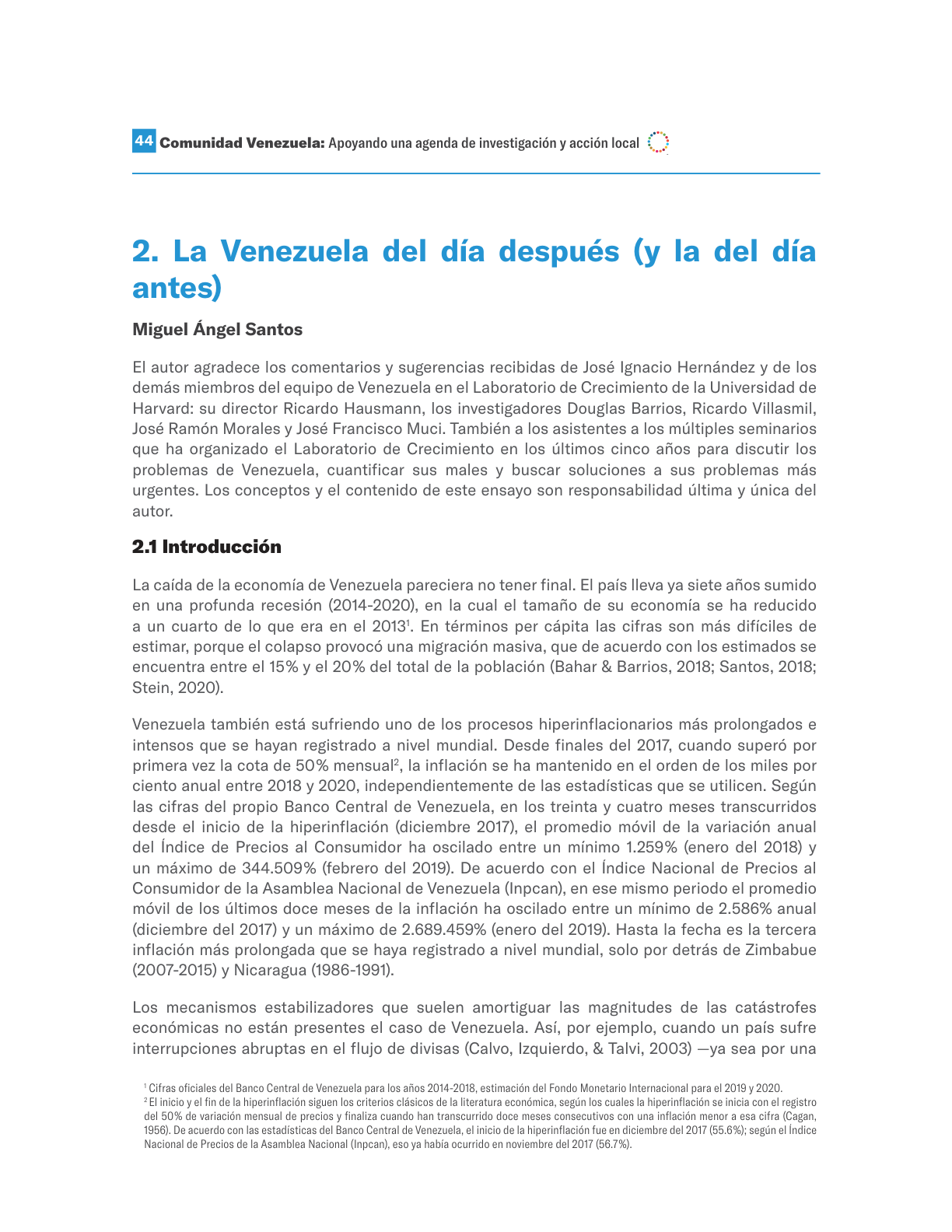
La Venezuela del día después y la del día antes: colapso económico, orígenes institucionales y hoja de ruta para la recuperación
La caída de la economía de Venezuela pareciera no tener final. El país lleva ya siete años sumido en una profunda recesión (2014-2020), en la cual el tamaño de su economía se ha reducido a un cuarto de lo que era en el 2013 1 . En términos per cápita las cifras son más difíciles…
-
 Venezuela
Impact of the 2017 Sanctions on Venezuela: Revisiting the Evidence
In a paper titled “Economic sanctions as collective punishment: The case of Venezuela” (Weisbrot and Sachs, 2019), the authors—henceforth referred to as WS—set out to assess the causal effects of the financial sanctions imposed by the United States on Venezuela in August 2017.…
-
 Hermosillo
Is There Life After Ford? Structural Transformation and Inclusive Growth in Hermosillo, Sonora
Even within the low-growth context that prevailed in Mexico between 2005 and 2015, gross domestic product (GDP) per capita in Hermosillo (1.3%) fell below the federal average (1.4%). Two distinctive periods in terms of growth performance are salient within that decade. Between…
-
 Jordania
Female Labor in Jordan: A Systematic Analysis of Barriers and Opportunities
Women in Jordan are excluded from labor market opportunities at among the highest rates in the world. Previous efforts to explain this outcome have focused on specific, isolated aspects of the problem and have not exploited available datasets to test across causal explanations.…
-
 Jordania
Jordan: The Elements of a Growth Strategy — Diagnosing Constraints and Identifying Export Opportunities for a Resilient Economy
In the decade prior to the global financial crisis of 2008-2009, Jordan enjoyed a period of impressive macroeconomic performance. The prolonged expansion was export-led, with total exports of goods and services tripling over that period. The boom was not only due to better…
-
 Hermosillo
There Is a Future After Cars: Economic Growth Analysis for Hermosillo
For 30 years, Hermosillo has been wondering whether it has a future after Ford. Until the early 1980s, the city relied mainly on agricultural activity. When the multinational motor company arrived in this northwestern Mexican city in 1986, it changed the history of a region that…
-
 Venezuela
Code Red: Venezuela’s Oil and Debt Crises
The economic and humanitarian crisis in Venezuela took a turn for the worse in the second half of 2017. Unofficial GDP and inflation measures—the country has long ceased to provide economic indicators—show a sharp deterioration. Declines in oil production and exports are…
-
 Other
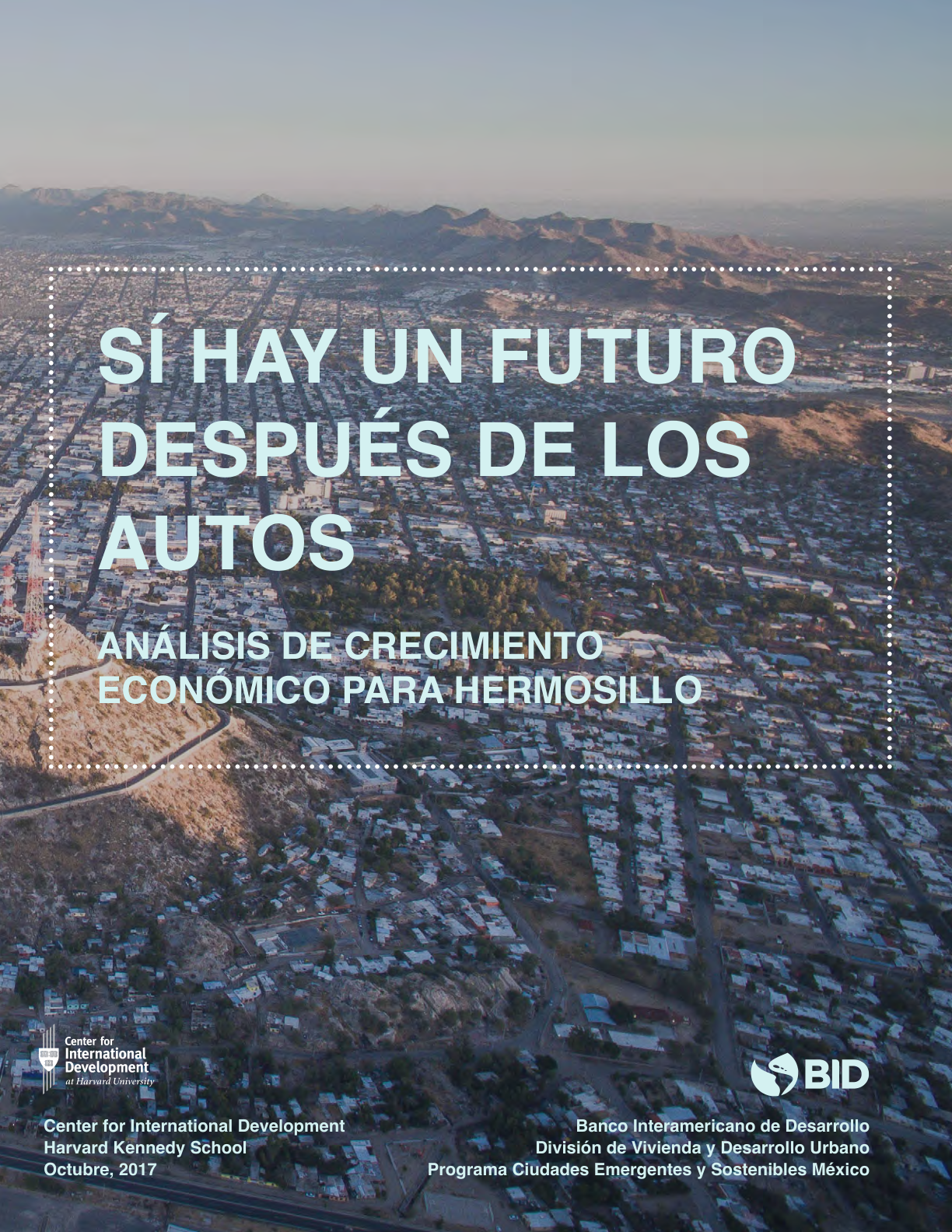
OtherEstudio Harvard-BID: Análisis de Crecimiento Económico de Hermosillo
Hermosillo lleva 30 años preguntándose si hay un futuro después de la Ford. Cuando esa multinacional automotriz llegó a esta ciudad del noroeste de México, en 1986, cambió la historia de una región que hasta entonces dependía en buena medida de la actividad agrícola. La…
-
 Venezuela
Fool’s Gold: The Impact of Venezuelan Currency Devaluations on Multinational Stock Prices
This paper documents negative cumulative abnormal returns (CARs) to five exchange rate devaluations in Venezuela within the context of stiff exchange controls and large black-market premiums, using daily stock prices for 110 multinational corporations with Venezuelan…
-
 Panamá
Cambiando esclusas: Un diagnóstico de crecimiento de Panamá
Panamá ha sido una de las economías de mayor crecimiento en el mundo durante la última década, llegando a duplicar su ingreso per cápita entre 2004 y 2014. Alrededor del Canal de Panamá ha prosperado una vibrante red exportadora de servicios -puertos, logística, comercio,…
-
 Chiapas / México
Chiapas Growth Diagnostics: The Trap of Low Productivity
Chiapas is the state with the lowest income per capita in Mexico and the state that grew the least during the last decade. Therefore, the income gap between Chiapas and the rest of Mexico has widened remarkably. This weak performance contrasts sharply with the relative…
-
 Panamá
Appraising the Economic Potential of Panama: Policy Recommendations for Sustainable and Inclusive Growth
“ Once we regain the sovereignty over the Canal, our exports will grow faster. If we cannot increase the toll rates, we will have to develop along the shores of the Canal. ” Those were the of words Omar Torrijos to writer Graham Greene in 1978 1 , less than a year after the…
-
 Venezuela
Apocalypse Now: Venezuela, Oil and the Challenges of Economic Reconstruction
There is no constitutional cure to the country’s descent into economic chaos. Even if Maduro succeeded in convening a Constitutional Assembly and installed himself as absolute ruler, his inability to fix the economy would keep his hold onto power tenuous at best. A Maduro…
-
 Panamá
Las Zonas Económicas Especiales de Panamá: Difusión tecnológica vía mercado laboral
Durante la última década, Panamá ha experimentado un notable progreso económico, en el que duplicó su ingreso per cápita. El crecimiento del país se debe en gran parte al surgimiento de un sector de servicios altamente competitivo relacionado a las actividades que rodean al…
-
 Panamá
Shifting Gears: A Growth Diagnostic of Panama
Panama has been one of the fastest growing economies in the world, duplicating its income per capita between 2004 and 2014. A vibrant network of exportable services surrounding the Panama Canal – ports, logistics, trade, communications, and financial services – has burgeoned.…
-
 Chiapas / México
Hacia un Chiapas próspero y productivo: Recomendaciones de política para el desarrollo
Chiapas no sólo es la entidad más pobre de México, sino también la que menos creció durante la última década. En contraste con las predicciones de la teoría neoclásica y con la experiencia de muchos países, en lugar de converger, la brecha que separa a Chiapas del resto de…
-
 Chiapas / México
Por qué Chiapas es pobre
Chiapas es, comoquiera que se le mire, el estado más atrasado de México. Su ingreso por habitante es el más bajo de las 32 entidades federativas, apenas 40% de la media nacional (Gráfico No. 1). Su tasa de crecimiento durante la década 2003-2013 también fue la más baja (0,2%) 1…
-
 Chiapas / México
La Complejidad Económica de Chiapas: Análisis de capacidades y posibilidades de diversificación productiva
Chiapas es el estado más pobre de México, y también el menos diversificado en su estructura productiva. Según los hallazgos de este reporte, esa dualidad no es una coincidencia casual. La escasa complejidad económica de Chiapas, medida tanto por la escasa sofisticación de sus…
-
 Other
OtherLa trampa de la baja productividad: Diagnóstico de crecimiento de Chiapas
Chiapas no sólo es la entidad de menor ingreso per cápita de México, sino también la que menos creció durante la última década. En consecuencia, la brecha que lo separa del resto del país ha venido ampliándose significativamente. Este desempeño contrasta con el entorno de…
-
 Other
OtherCruzton: Piloto de Crecimiento Inclusivo en Chiapas
Chiapas no sólo es el estado de menor ingreso per cápita de México, sino también el que menos creció entre 2003-2013. También es la entidad con mayor pobreza, independientemente del indicador que se utilice. 1 Para analizar su pobre desempeño es imprescindible tener en cuenta su…